We were both suffering a little this morning, coughing and sneezing. This can be the one bad thing about a cruise - 'kennel cough'. Once one person gets a cold everyone gets a cold. We sat by the open window and our cabin attendant, Chan, came in to do his cleaning around us. We must have looked a sorry sight for he brought us another large box of tissues as he left.
Just before lunch we came to the confluence of the Irrawaddy and Chindwin Rivers. The Chindwin is the largest tributary of the Irrawaddy.
There was a noticeable increase in large ship traffic.

We went to lunch where Michael had the urge for something different, and on the menu under the 'always available' was the answer - a burger and chips!
After lunch we docked at the village of Yandabo, where The Treaty of Yandabo (which ended the First Anglo-Burmese War) was signed on 24th of Feb 1826.


We were not visiting for that reason, we were here to see the potters.
Yandabo is a village of about 400 houses. Of which around 30 families are potters; the other villagers are farmers, fishermen or work to provide the raw material such as clay or wood for the kilns to fire the pots.The women make the pots and it’s a two-girl job with one potting while the other operates the wheel using a treadle. They take it in turns and chat as they work.


Other women decorate the pots; sitting with a pot on their lap and using a wooden spatula they gently beat the base of the pot into a smooth shape and then use a wood stamp to imprint the pattern.


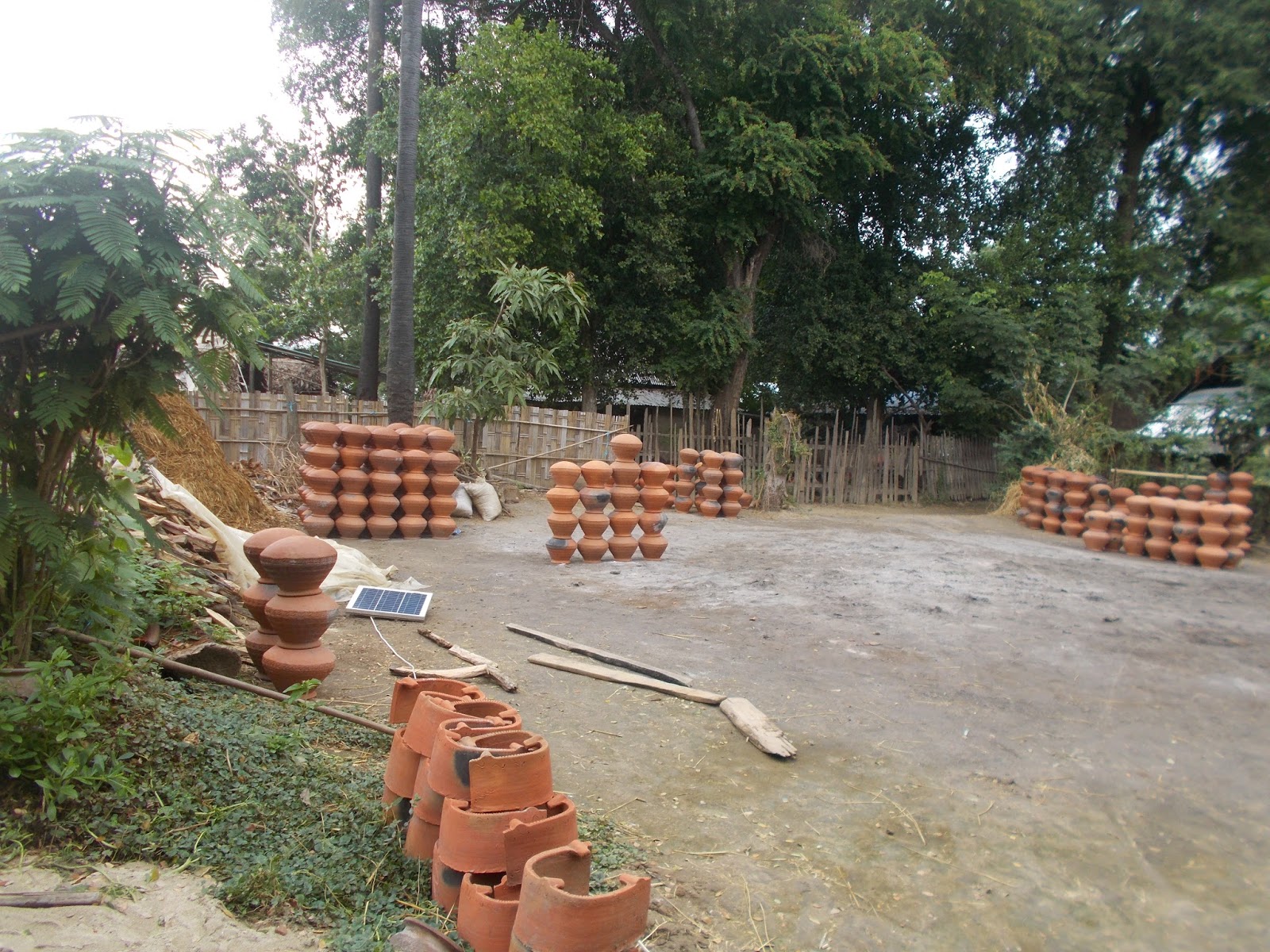
Each potter household has it's trademark pattern. The men then arrange the pots in a circular pattern to dry. There may be up to three thousand pots in a single layer that’s covered with a large pile of ash, straw and wood then set on fire. The temperature in this kiln reaches 1200C and the drying process can take three or four days, including cooling. Unfortunately due to the rain recently there were no kilns operating on our visit, But we saw everything involved.


At the end of the process the pots have changed from dull grey /brown to a lovely terracotta colour. They are then transported in traditional fashion ( each basket carrying 8 pots, each pot weighs around 1.8kgs!) to the quayside where they are transported by boat all over the country. Around 2 million pots leave Yandabo each year.

The pots are water pots and you can see them all over the country. Every street and roadway has several sitting there, with ladles or cups, for all to use. The water comes from the river. Looking at the river there's no way any of us would touch the water, but it's all the locals have and their immune system is a lot stronger than ours.
The rounded bottom is where the sediment settles out, the water does become clear but we all thought of those unseen microbes.

We had a short stroll around a little more of the village and then went back to the boat.

We set sail from Yandabo at 4.45 and at 6.00 were at our night mooring at Sameikkon Village.
That night I tried the cocktail - SMK. Whisky, White Wine, Lime and Grapefuit Juice. What can I say, strange but drinkable.
At cocktail hour we were in for an incredible treat. It was unpublicised and I think I'll keep it a secret too. No spoiler alert - no spoiler, just to say that it was an incredible evening and a beautiful memory of the cruise.
After dinner we passed on the evening's entertainment - Crew entertainment.
We took our coughs off to bed early.
Day 12 Monday Dec 11th.

Once again our tours would be in the afternoon so we had a nice slow start.


We went up the almost deserted sundeck and sat relaxing, dozing and reading our books until at 11.00 I went to the 'disembarkation talk'. We were given new luggage tags and the time table was explained to us. Quite a lot of the passengers are off to Inle Lake, as a 3 day extension to the cruise, but we would be going to the airport for a flight to Singapore.
Then it was lunch time.
After lunch we arrived at Inwa and watched the crew wading through mud trying to find a stable place for the gang plank. Once again the mattock came into use and they soon had it safe for one and all.
The town of Inla was an imperial capital from 14th to 19th centuries but was finally abandoned after being completely destroyed in earthquakes in 1839.
We were here to visit the Bagaya Monastery.
To travel to the monastery we would be taking a horse and cart. This time we both climbed in the back but the balance was a little too 'rear heavy' so I climbed up on the front seat. Our horse was eager to be off and didn't like waiting for the others, he kept stamping his feet and lifting his back legs.

Then we were off, it wasn't a bad road. It was bitumen but we had to share it with lots of motorbikes, cars, trucks and stock (cattle and pigs)!


It was only a 10 minute ride out to the monastery where we had a look around. The teak wood Monastery was first built in 1593. It stands in the middle of wide paddy fields. The size and scale of the place was amazing. How they built using such huge timbers without modern equipment is always thought provoking. Walking barefoot on the smooth teak boards was very pleasant.


Then it was time to head back to the cart for a 20 minute ride to the jetty in the old part of town to catch the ferry across to where our coaches were waiting to take us to our next stop.
The quality of the road deteriorated - a lot. No way could Itake photos, just hang on. The old road had been made of bricks which had now mostly disappeared and following the recent rain there was quite a lot of mud, as well as pot holes and horse manure.
The poor horses had it tough. (One member of our tour saw one horse stagger and fall down, it was trying to carry 4 Europeans. Thomas, our guide ran over and ordered the people out of the cart, the horse got up and another cart came up to split up the load - carrying two people in each. So glad we didn't see it).
There seemed to be horse and carts everywhere, each one had a registration number. I saw number 197 and asked Thomas if he knew how many carts there were in town -"Two hundred" he replied.
At the jetty at the Myitnge River Crossing we lined up for the ferry. We managed to get on the first run. It was a very short crossing, and we were soon up the few steps on the other side and found our waiting bus.


The bus took us to Amarapura where we called at a Silk Weaving Workshop and Showroom. The place was lovely, very quiet and very clean. Each loom was being operated by 2 girls who were calmly weaving. The cloth was such an intricate colourful pattern of 200 threads.There's no way I could understand the chart they were following or how they managed not to mix up the subtle changes in shade of the bobbins. Incredible. We had a quick visit to the showroom but despite the beautiful fabrics couldn't see the need for a silk scarf. Interestingly the silk comes from China, we were told that being Buddhists the Burmese cannot kill a silk worm. The dye comes from Germany, the best quality there is.


Then the bus continued to the highlight of the day - for some, the highlight of the trip - U Bein Bridge. U Bein Bridge was built around 1850 and is believed to be the oldest and longest teak bridge int the world. It spans the Taungthaman Lake near Amarapura and is famed for it's spectacular sunsets.
We were in for a treat - watching the sunset, drinking champagne, in a sampan, out on the Lake.

Most people opted to walk a little way (400 metres) along the bridge and then climb down the steps and board their sampan. Michael didn't want to walk on the bridge and so that it would be easier for the boatman to find me, so that we were in the same boat (as it were), I opted not to walk either.

We boarded a sampan and were rowed out into the Lake. The water depth was apparently just under 2 foot so we felt very safe. We sailed under the bridge and saw a couple of locals throwing their fishing nets, under the watchful eye of a Cormorant.


Then as we headed back under the bridge we saw the other passengers queued up for their boats. The bar staff from the Samatha were sitting in a boat too - handing out champagne! They'd even brought along a can of Soda Water for Michael as he doesn't drink. Wonderful service!!

Then all the boats lined up, some jockeying for better spots, waiting for that spectacular sight. We were not disappointed. This evening the sunset did not disappoint, truly beautiful. We all sat in silence, cameras clicking and glasses clinking then as the sun disappeared we started for the shore.


We were alongside friends from the boat and started egging on our oarsman - likening it to the Oxford boat race. Then the race was on as others joined in, everyone egging on their skipper..
It was great fun, maybe the oarsmen always race; they seemed to enjoy it as much as everyone else.
The coach then took us back to the boat, which had sailed along to our night mooring spot - Sagaing.
I tried the cocktail tonight - Ava Bridge (Inwa is also known as Ava).
White Rum, Cranberry and Lime. There was no evidence of much Cranberry, it was very pale in colour and all I could taste was Rum. One was definitely enough.
After dinner we all went up onto the sundeck for the entertainment.
A traditional display of "Chin Lone" The art of playing cane ball.


The young lady was amazing. She started out playing with the cane ball, keeping it in the air, bouncing it on feet, knees and head, then it got more exciting with a lasso, then there were plates balanced on sticks too. Then it involved balancing on bricks, then balancing on stools, then the stools were balanced on small glass bottles. Then it was the plates, on the stools, on the bottles.
Then there was a burning rope. Everyone was holding their breath.
She was just amazing (I keep using that word, I know). It was a superb show.
(Thomas told us later that the young lady was not as good as she had been, she's now older, married and had a baby!!)
We went to bed with our head full of sunsets and bouncing cane balls.